Boss Rummy on the screen
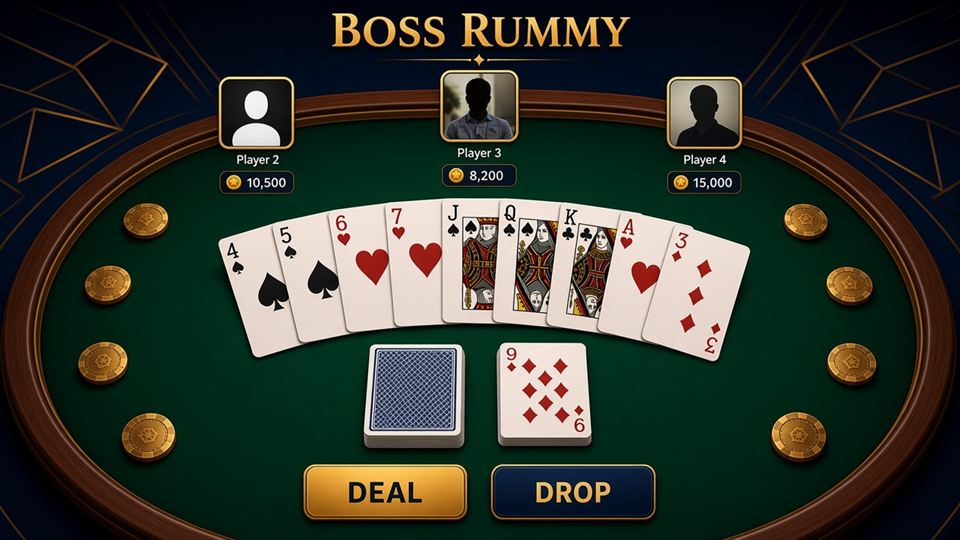
How to download and install Boss Rummy
Use the button on this page to download the Boss Rummy game. The file is an Android package, 34MB, version 1.1.6.
Download Boss Rummy
Tap the button on this page. It opens the address where the APK is.
Save the Boss Rummy APK
Wait until the phone has finished saving the APK, then open that file.
Allow the Boss Rummy install
If the phone asks about an unknown source, allow this install once, following the system prompt.
Open the Boss Rummy app
When the install finishes, open the app from the home screen, then register an account as the next section says.
How to register for Boss Rummy
Open registration for Boss Rummy
After you open the app, tap Register. Do not submit the form twice.
Enter your mobile number for Boss Rummy
Use your own mobile number to receive the code, then set a login password.
Check the account, then open Boss Rummy
Check that the account is open, then choose the game you want to play.
How to log in to Boss Rummy
Log in to Boss Rummy with your mobile number
If you already have an account, tap Log in. Enter the mobile number and password you used when you registered.
If you forget the Boss Rummy password
Tap Forgot password. Use the same mobile number to receive a code, then set a new password. Do not submit it twice.
Boss Rummy details
| Game | Boss Rummy |
|---|---|
| Category | Card games |
| Version | 1.1.6 |
| APK size | 34MB |
| System | Android |
| Language | English and Hindi. You switch them inside the app. |
| Age | 18+ |
| Price | Boss Rummy is free to download |
What Boss Rummy is like
- Each player has thirteen cards. First make one pure sequence, then make a second sequence, then make the remaining cards into sequences or sets, and then declare.
- A sequence is a group of the same suit in a run of ranks. A set is three or four cards of the same rank. A pure sequence cannot be filled with a joker.
- You can sort the hand. Each turn you draw one card and discard one. If the groups are not ready, you can drop. After a declare, the groups are checked. If they are wrong, the penalty is counted by this table. This page does not state that figure.
- The discard pile is face up, and the closed deck is covered. Everyone at the table can see the card you take from the discard pile.
Why play Boss Rummy
Boss Rummy is likely to suit players who like to group the cards themselves, then choose the moment to declare. The cards have to make a pure sequence first before you can gather the rest.
Every turn is a choice: keep this card to fill the next group, or throw it away and hold one less loose card. The discard pile is face up, so you can see whether it helps before you take it.
How to play Boss Rummy
-
Look at this table first
When you enter the room, first see how many people are sitting. The table shows how scoring works. This page does not state that figure.
-
See this round's joker
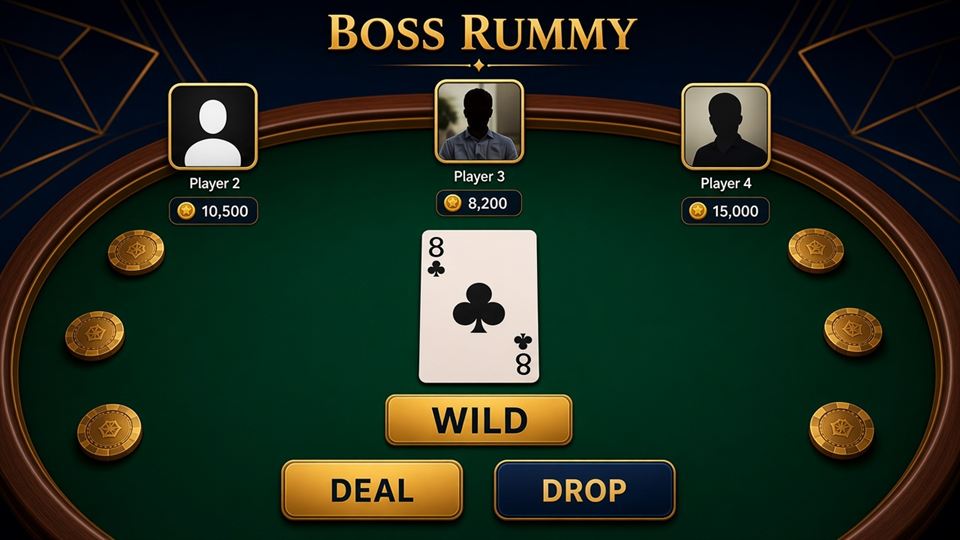
At the start, one more card is turned up, and it sets this round's joker rank. You hold thirteen cards.
This round's joker rank -
Draw one, then discard one
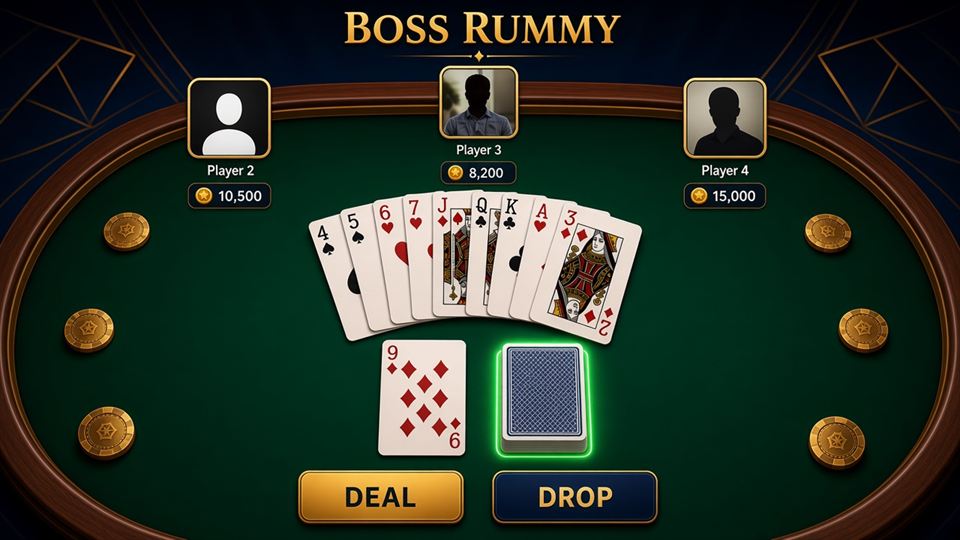
On your turn, draw one from the closed deck, or take the top card of the discard pile, then discard one card. The hand returns to thirteen cards.
The closed deck and the discard pile -
Make a pure sequence first
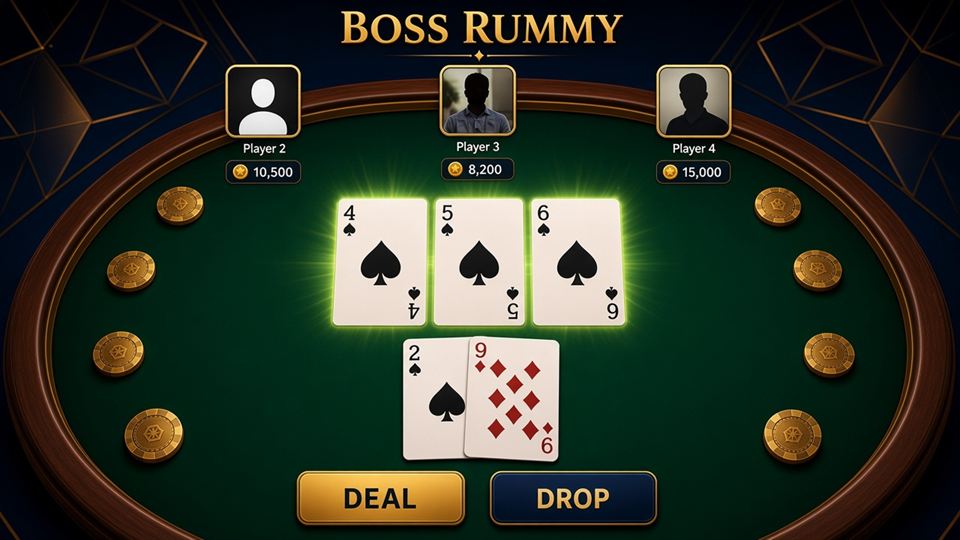
First find a group of the same suit, in a run, that was not made with a joker. For example, the 4, 5, and 6 of spades.
A pure sequence -
Then deal with the remaining cards
You still need another sequence, and that one may use a joker. Make the remaining cards into sequences or sets. A joker cannot be used to make a pure sequence.
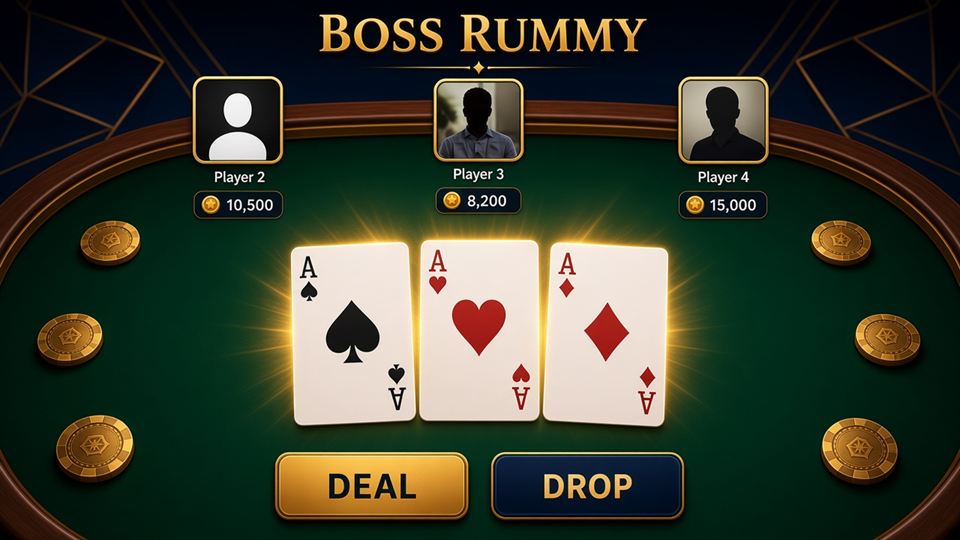
A set -
Declare after the groups are made
After all thirteen cards are in groups, discard the extra card, then show the groups. If the groups are wrong, the penalty is counted by this table. This page does not state that figure.
Playing Boss Rummy well
What to do
- Make a pure sequence first, then make a second sequence. Only when those two groups are made does a set count in the declare.
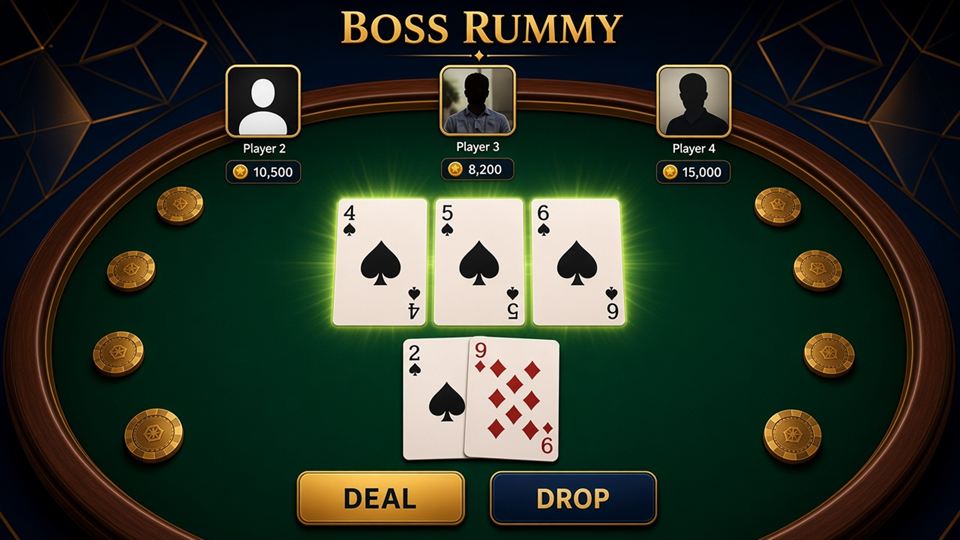
Make the pure sequence first - Before you take from the discard pile, see which group this card fills. The card is face up, and the others can see it too.
- Throw high loose cards first. Ace, king, queen, jack, and 10 are 10 points each. The longer you keep them, the more you lose when someone else declares.
- Before you declare, separate the groups and check them again: is there a pure sequence, is there a second sequence, and is any card left on its own.
- If the groups are not ready, look at this table's drop score first. Dropping at the start is usually cheaper than forcing a declare halfway through. This page does not state that score.
What not to do
- Do not gather a set first. Until there is a pure sequence, a set cannot be used to declare. In the image, three aces are lit, but declare is crossed out.
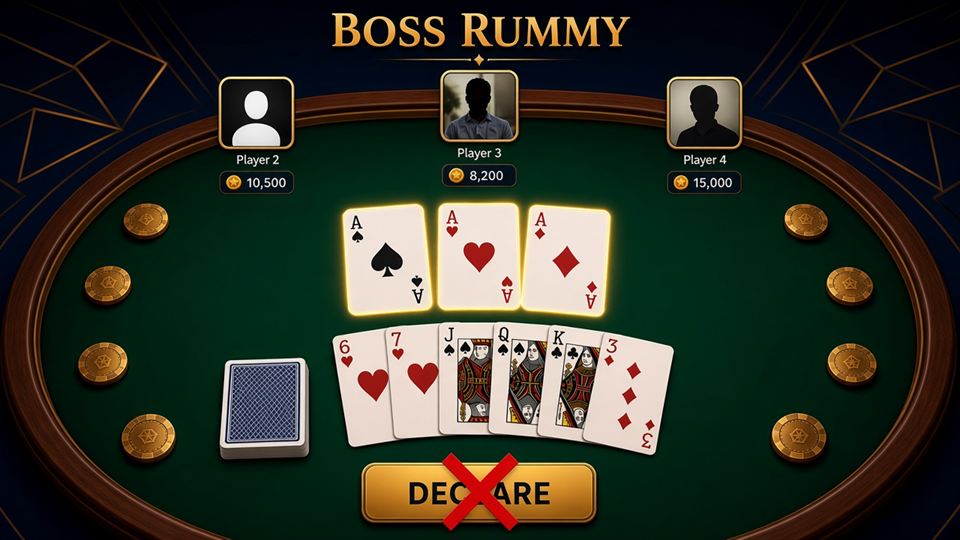
Do not declare without a pure sequence - Do not lay king, ace, and 2 out as one group. The ace cannot wrap from the king round to the 2.
- Do not discard at once a card you have just taken from the discard pile. The card you took from the discard pile cannot be discarded on this turn.
- Do not pick up the joker from the discard pile. Most tables do not allow that pickup. Read this table's notes first.
- Do not keep an ace and a king while you wait for the next card. These are the highest-value ungrouped cards.
- Do not declare before the groups are ready. If the pure sequence is missing, it is counted at this table's highest penalty. This page does not state that figure.
Rules of Boss Rummy
- Which cards are used
-
- Usually two packs, plus the printed jokers.
- From 2 to 6 players, 13 cards each.
- A table with fewer players sometimes uses only one pack. See it on this table when you enter. This page does not state it.
- The two piles
-
- The closed deck is covered, and the discard pile shows its top card.
- At the start, one more card is turned up, and it sets this round's joker rank.
- Cards of that rank, and the printed jokers, are all jokers.
- If the card turned up is a printed joker, aces become the wild cards for that hand.
- How a turn goes
-
- Draw one first, then discard one, and the hand returns to 13 cards.
- You may draw from the closed deck, or take the top card of the discard pile.
- The card you took from the discard pile cannot be discarded straight back on this turn.
- Once a joker is on the discard pile, the next hand usually cannot pick it up. Follow this table's notes.
- A pure sequence
-
- At least three cards, the same suit, in a run of ranks, with no gap filled by a joker.
- A group can be longer.
- The ace can run as ace, 2, 3, and it can also run as queen, king, ace.
- It cannot run as king, ace, 2.
- A card of the joker rank is used as its own suit and rank, and the group still counts as a pure sequence.
- A sequence
-
- The same suit, in a run of ranks.
- A joker can fill a gap in the middle.
- This group cannot stand in for a pure sequence.
- A set
-
- Three or four cards, the same rank, different suits.
- A joker can be added into a set.
- Two cards do not count, and five cards do not count either.
- When you can declare
-
- All thirteen cards have to be in groups.
- At least two sequences, and one of them must be a pure sequence.
- Only when the pure sequence and the second sequence are both there can the remaining cards count as sequences or sets.
- After the groups are made, discard the extra card, then show the groups.
- A wrong declare
-
- If the pure sequence is missing, it is counted at this table's highest penalty. This page does not state that figure.
- If there is a pure sequence but no second sequence, the sets do not count, and those cards are still scored.
- If the declare is wrong, this round usually continues.
- How much the penalty is depends on the table you are sitting at. This page does not state it.
- How the points are counted
-
- Count only the cards that are not in a valid group.
- Ace, king, queen, jack, and 10 are 10 points each.
- 2 to 9 count as their face value, and a joker is 0.
- There is a points cap for each hand, shown on this table. This page does not state that figure.
- Dropping
-
- If the groups are not ready, you can drop and leave this round.
- Dropping at the start and dropping midway through the round carry different point penalties.
- A wrong declare is usually dearer.
- The figures are in this table's notes. This page does not state them. Do not rely on another table.
- The names on the table
-
- The table may be marked Points, Pool, or Deals.
- The names differ, but the groups for this round are still the set above.
- When you enter, see which kind this table is marked as.